

TopView has recently launched TOMCAT – flighT OPeration Manager i-Conspicuity and digitAl reporT, a new Demonstration Project co-funded by the European Space Agency (ESA) within its Business Applications & Space Solutions (BASS) programme.
The project addresses the operational and regulatory challenges faced by General Aviation (GA) pilots and aeroclub managers, who increasingly operate in airspace shared with drones and within the framework of new U-space regulations. TOMCAT aims to deliver a turnkey digital solution that covers all flight phases – from planning to post-flight reporting – leveraging satellite navigation, satellite communications and Earth observation to provide trusted, continuous and legally meaningful data.
Why TOMCAT: key challenges in General Aviation
Sport, leisure and training flights conducted by GA operators are evolving in a context where manned aircraft and drones share low-level airspace and must comply with increasingly complex regulatory requirements. In this environment, several issues emerge:
Fragmented, paper-based processes
Flight plans, airspace checks, logbooks and reports are often handled with separate tools or even on paper, creating extra workload, low interoperability and a higher risk of errors.Electronic conspicuity and U-space compliance
New rules demand that aircraft and drones be electronically visible and traceable. GA operators need cost-effective, easy-to-deploy solutions that do not require heavy on-board installations or ground infrastructure.Limited situational awareness in mixed traffic
In low-level and U-space airspace, pilots need reliable information on surrounding traffic – both manned and unmanned – to preserve safety margins and prevent conflicts.Need for robust, auditable operational records
Aeroclubs and flight schools must maintain certified flight records to support training, audits, insurance and potential legal claims. Traditional paper logbooks are not enough to guarantee integrity and evidential value.
TOMCAT has been conceived precisely to tackle these challenges, providing one integrated digital environment for flight operations in General Aviation.
System architecture: device, portal and gateway
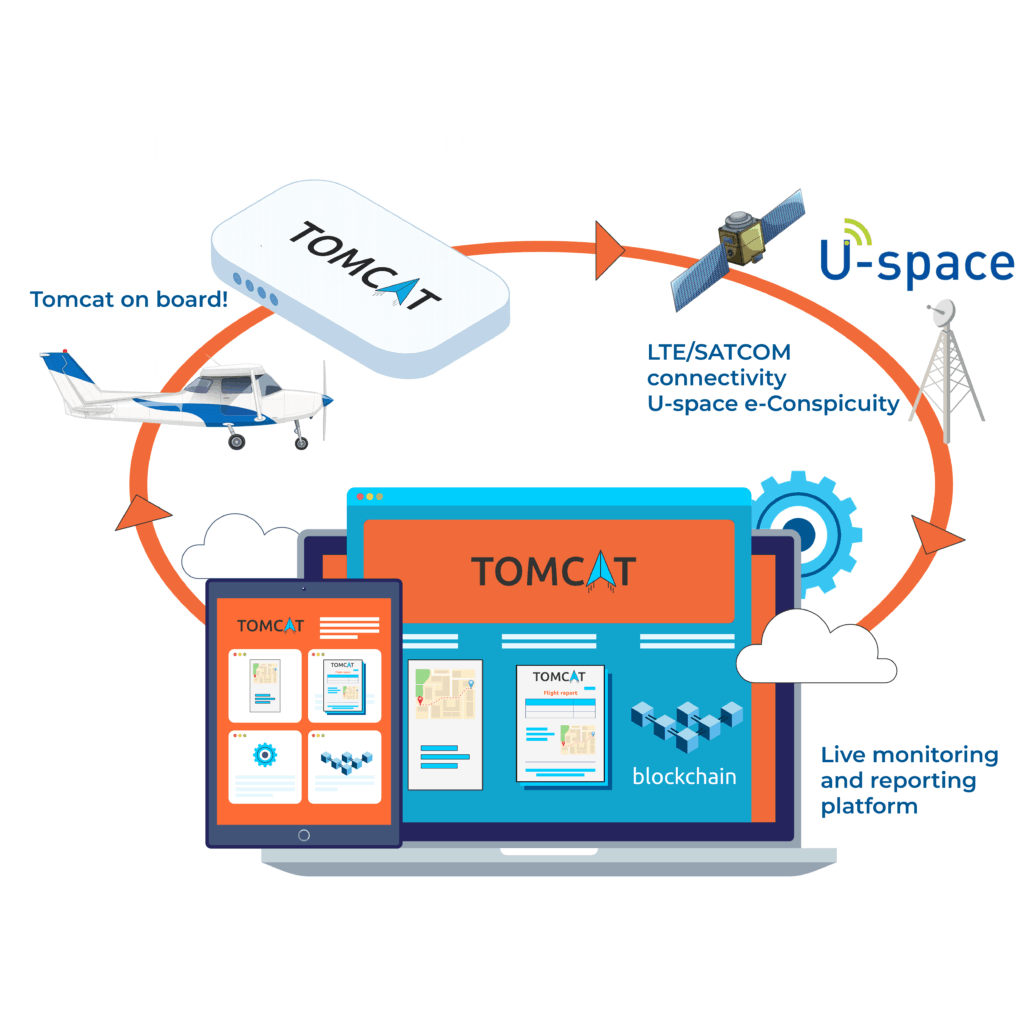
The TOMCAT service is built around three core components that together create a coherent digital ecosystem for GA operations:
Pollicino™ GA device
A compact, portable Electronic Flight Bag (EFB) unit installed in the cockpit. It tracks the aircraft using multi-constellation satellite navigation and transmits data via LTE and satellite links. This device is the operational enabler of authenticated, continuous tracking and e-conspicuity for GA.TOMCAT Portal
A secure web and mobile platform where pilots, instructors and aeroclub managers can:plan and submit flights
monitor live operations and aircraft status
access post-flight reports, certified logbooks and statistics
Device Gateway and certification service
A backend gateway receives and validates flight data, harmonises them with external information sources (e.g. terrain models, airspace data) and stores certified records on a blockchain infrastructure. This layer ensures data integrity, authenticity and legal robustness.
These components are designed to be easy to adopt by aeroclubs and GA operators, without the need for complex ground infrastructure or expensive avionics upgrades.
Space technologies at the core of TOMCAT
A distinctive feature of TOMCAT is its deep reliance on space assets to provide capabilities that go beyond those of conventional aviation IT systems:
Satellite Navigation – Galileo OSNMA
TOMCAT uses authenticated GNSS signals (e.g. Galileo OSNMA) to guarantee that positioning data originate from a legitimate satellite source. This is crucial for Authenticated Tracking services and for generating certified flight reports that are resilient to GNSS spoofing and manipulation.Earth Observation – Digital Terrain and Elevation Models
High-resolution terrain and elevation data support risk mapping and the Common Altitude Reference service. By providing a consistent altitude framework, TOMCAT helps manned aircraft and drones share the same altitude reference, reducing collision risks in low-level and U-space airspace.Satellite Communications – complementing LTE
Satellite links act as a backup to terrestrial LTE networks, providing connectivity in remote or poorly covered areas and above U-space limits. This dual-channel approach ensures that aircraft remain electronically visible and compliant with regulations throughout the flight.
By integrating these space assets, TOMCAT delivers a unique combination of safety, compliance and legal trust for General Aviation operations.
Target users and operational scenarios
TOMCAT has been designed around the needs of:
General Aviation pilots engaged in sport, leisure and training activity
Aeroclub managers and fleet coordinators, who must supervise multiple aircraft, pilots and guest users
Flight schools, which require reliable, auditable training records for students and instructors
Regulators and U-space stakeholders, interested in interoperable, scalable solutions for electronic conspicuity and mixed airspace integration
The pilot phase of the project focuses on Italy, where TopView already has a strong footprint in U-space and digital aviation projects, and where aeroclubs operate in diverse airspace conditions. The solution is conceived to be scalable to other EU countries as regulations and digitalisation efforts evolve.
Consortium and roles
TOMCAT is led by TopView S.r.l., acting as Prime Contractor. The project also involves Engage S.r.l. as subcontractor, contributing specialised competencies within the system design and validation activities. This partnership combines TopView’s expertise in U-space, GNSS and digital aviation with complementary skills in system engineering and service deployment.
Current status and next steps
TOMCAT was officially kicked off in July 2025 and is currently in the development and demonstration phase. Since project start, the team has:
interacted extensively with GA pilots and aeroclub managers to refine user needs and requirements
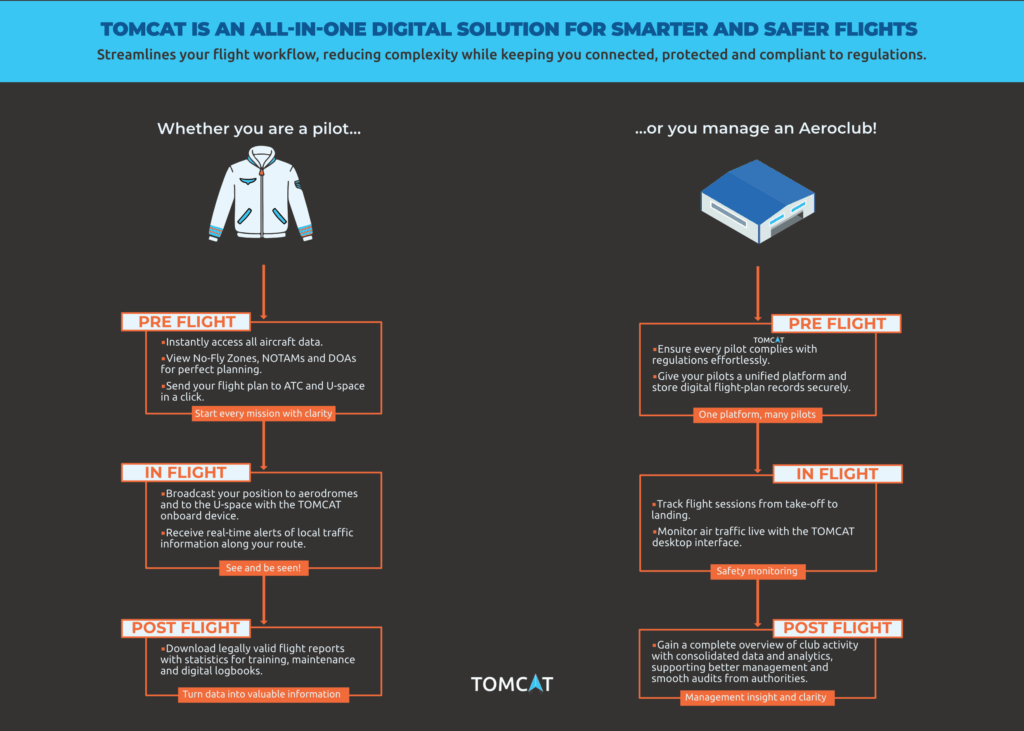
consolidated the service baseline and system concept, including pre-flight, in-flight and post-flight workflows
successfully completed the Baseline Design Review (BDR) in November 2025, confirming the technical foundations and roadmap for the demonstration phase
In the upcoming phases, TOMCAT will:
finalise integration of the Pollicino™ GA device, TOMCAT Portal and backend gateway
conduct a pilot campaign with selected aeroclubs, validating the solution in real operational scenarios
collect structured feedback from end users, authorities and U-space stakeholders to optimise usability, interoperability and regulatory compliance
The ultimate goal is to demonstrate that TOMCAT can improve safety, simplify regulatory compliance and accelerate the digital transformation of General Aviation – paving the way for commercial uptake by aeroclubs, flight schools and GA operators across Europe.
See on ESA website the TOMCAT Project page